
AI
STATE
OF THE ART

AI
STATE
OF THE ART
PATAGONIAN
THE STATE OF AI
WHERE INNOVATION
HAS NO BOUNDS
Brief overview of the current AI landscape.
By Mercedes Caracotche and Rodrigo Falcó.
This “AI State of the Art” is more than a mere report; it is a roadmap crafted by Patagonian’s technical experts. It details our understanding of the technology and our innovative application of AI to solve real problems. We’re dedicated to building solutions safely and responsibly. We want to share our relentless work in navigating the AI outcomes race to ensure Patagonian leads the charge in delivering innovative digital solutions within this evolving landscape.
It’s a strong testament to how our teams are not tracking external tech shifts; they’re actively building the core capabilities and navigating the complexities required to deliver real value.
This specific “AI State of the Art” reflects our findings as of July 2025. Given the rapid pace of technological advancements, especially in AI, continuous research is mandatory. Therefore, we commit to publishing updated insights twice a year to keep our vision sharp.
Key AI trends
Experts insights across Patagonian departments
Artificial intelligence
The AI & Innovation group pilots the newest models (GPT, Gemini, Claude) and the latest frameworks (LangGraph, CrewAI, Autogen, OpenAI Agents, MCP Servers) weeks or months before they become mainstream.
Faster learning & delivery

85%
Patagonians use AI weekly

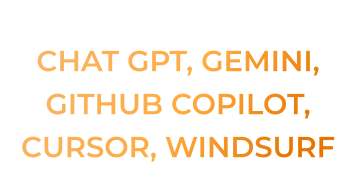

Advanced models: LLMs, edge computing & multimodal systems
- Growing LLMs deliver enhanced capabilities at reduced costs.
- Open-source models (Mixtral, DeepSeek) enable on-premise deployment and edge computing solutions.
- Context windows of up to 2M tokens enable working with large amounts of code at once.
- Multimodal AI systems process text, images, audio, and video within a single prompt.
Enterprise solutions: RAG, orchestration & low-Code platforms
- Orchestration frameworks (LangGraph, CrewAI) transform complex workflows into prompt-based operations.
- RAG and fine-tuning enable AI to leverage private data while maintaining accuracy.
- Low-code/No-code tools platforms democratize development.
- Synthetic data enables rapid POC testing while protecting privacy.
Quality control & regulatory compliance tools
- Evaluation tools (Windsurf and Ragas) ensure measurable AI quality.
- Governance toolkits (Azure, HuggingFace) provide robust compliance frameworks for enterprise AI deployment.
AI is increasingly more accessible, reliable, and practical for businesses of all sizes
The future is intelligent!
DevOps
By embedding AI into the heart of our operations, we’re forging a new era of proactive and resilient systems, where potential issues are resolved before they arise and resources flex intuitively with demand.
AI - Driven monitoring
Empowers teams with intelligent insights throughout the CI/CD pipeline and production.
Provides actionable intelligence that helps developers proactively fix code issues and operators maintain a stable environment.

Anomaly detection
Early detection prevents small issues from escalating into major incidents.
AI’s ability to detect anomalies and predict issues can lead to a lower percentage of deployments that cause incidents or require rollback.

Predictive infrastructure scaling

Traditional auto-scaling in DevOps relies on reactive rules (e.g., scale up when CPU utilization exceeds 80% for 5 minutes), which leads to:
- Performance degradation
- Delayed response to spikes

AI - Driven monitoring
Empowers teams with intelligent insights throughout the CI/CD pipeline and production.
Provides actionable intelligence that helps developers proactively fix code issues and operators maintain a stable environment.
AI
Anomaly detection
Early detection prevents small issues from escalating into major incidents.
AI’s ability to detect anomalies and predict issues can lead to a lower percentage of deployments that cause incidents or require rollback.
.
…..
Predictive infraestructure scaling
Traditional auto-scaling in DevOps relies on reactive rules (e.g., scale up when CPU utilization exceeds 80% for 5 minutes), which leads to:
- Performance degradation
- Delayed response to spikes
.
…..

How does AI transform operational data into action?
Write smarter IaC (Infrastructure as Code)
GitHub Copilot assists engineers by generating code for platforms like Terraform and AWS CloudFormation.Predict and prepare for demand
AWS Auto Scaling uses ML to forecast traffic trends and scale resources automatically (Predictive Scaling).Analyze and act with AIOps platforms
AWS DevOps Guru leverages AI/ML to detect anomalies, forecast future resource needs, and trigger automated actions.Development
Generative AI is transforming software development, enabling developers to write code faster and more efficiently. Tools like Cursor stand out by offering an AI-native coding environment that provides context-aware suggestions, automates tasks, and facilitates deeper interaction with entire codebases.
GenAI
higher developer
productivity
From words to code
in seconds.
GitHub Copilot and Cursor are revolutionizing code writing by providing contextually relevant suggestions and generating entire functions based on comments or requirements.
AI-powered
design patterns
LLMs analyze codebases to recommend architectural improvements and implement complex patterns like microservices. These AI tools generate boilerplate code for design patterns while providing clear rationale for architectural decisions.
Intelligent
code review
Smart code review tools like CodeRabbit scan codebases to detect security vulnerabilities and logic errors that traditional tools might miss, preventing potential issues before they reach production environments.
GenAI
improves developer productivity
From words to code in seconds
GitHub Copilot and Cursor are revolutionizing code writing by providing contextually relevant suggestions and generating entire functions based on comments or requirements.
Intelligent code review
Smart code review tools like CodeRabbit scan codebases to detect security vulnerabilities and logic errors that traditional tools might miss, preventing potential issues before they reach production environments.
AI-powered design patterns
LLMs analyze codebases to recommend architectural improvements and implement complex patterns like microservices. These AI tools generate boilerplate code for design patterns while providing clear rationale for architectural decisions.
n8n + AI agents
In client environments, we use n8n + AI agents to create smart workflows.

Automated email validation
Checking for digital signatures, even in image-based formats.

Summarization bots
After tech team meetings, AI processes, transcripts, and generates newsletters — fully custom, independent of 3rd-party tools.

Attendance trackers
Logging participants and durations into a DB post-meeting.
Automated email validation
Checking for digital signatures, even in image-base formats.
Summarization bots
After tech team meetings, AI processes, transcripts, and generates newsletters — fully custom, independent of 3rd-party tools.
Attendance trackers
Logging participants and durations into a DB post-meeting.
Experience
From anticipating individual needs to seamlessly integrating AI into daily workflows, we’re building a future where interactions are intuitive and every team member is empowered with intelligent assistance.
Smarter interactions, seamless support.
- Communication that resonates: messages and content that adapt in real time to each user, creating stronger impact and engagement.
- Recommendations that convert: promotions and products tailored to each customer’s interests, powered by real data.
- Growth with no extra effort: smart automation that boosts conversion and loyalty without increasing operational load.
Real-time relevance that drives results.
- Content that adapts to users: AI customizes content and interfaces in real time, based on individual behaviors and preferences.
- Promotions that truly resonate: generative AI creates personalized emails, offers, and recommendations using browsing, purchase and demographic data.
- Higher engagement, higher conversion: deeper personalization means stronger user connections and measurable business outcomes.
Amplify creativity, accelerate innovation.
- Reduce routine, unleash focus: AI automates repetitive tasks so UX teams can focus on strategy, research, and user insight.
- Smarter tools, better understanding: AI helps process large volumes of user data, leading to more accurate personalization and improved accessibility.
- Faster workflows, deeper impact: from ideation to execution, AI-powered assistants accelerate design cycles without losing human empathy.

Conversational Design
Smarter interactions, seamless support.
- Communication that resonates: messages and content that adapt in real time to each user, creating stronger impact and engagement.
- Recommendations that convert: promotions and products tailored to each customer’s interests, powered by real data.
- Growth with no extra effort: smart automation that boosts conversion and loyalty without increasing operational load.

Hyper-personalized experience
Real-time relevance that drives results.
- Content that adapts to users: AI customizes content and interfaces in real time, based on individual behaviors and preferences.
- Promotions that truly resonate: generative AI creates personalized emails, offers, and recommendations using browsing, purchase and demographic data.
- Higher engagement, higher conversion: deeper personalization means stronger user connections and measurable business outcomes.

AI-augmented workforce
Amplify creativity, accelerate innovation.
- Reduce routine, unleash focus: AI automates repetitive tasks so UX teams can focus on strategy, research, and user insight.
- Smarter tools, better understanding: AI helps process large volumes of user data, leading to more accurate personalization and improved accessibility.
- Faster workflows, deeper impact: from ideation to execution, AI-powered assistants accelerate design cycles without losing human empathy.

AI-driven personalization and conversational design enable responsive, user-centric interactions. Combined with automation and insights from AI-augmented tools, experience evolves into a strategic driver of efficiency and value.
Architecture
Software traditionally required human operators; now, AI agents execute directly. This shift lets us define strategic objectives: we establish ‘what’ we want to achieve, and intelligent systems determine and execute the ‘how’. In solution architecture, this redefines our role towards strategic impact over operational execution.
How is AI changing Architecture?
Agentic AI
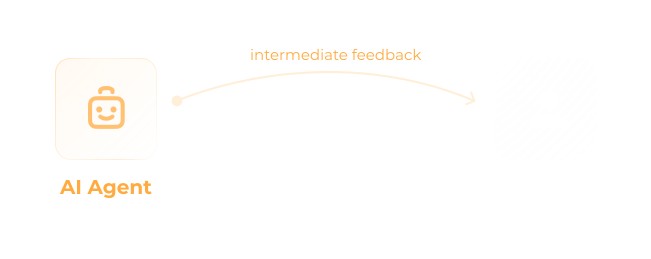
Act autonomously, adapt in real time, and solve multi-step problems based on context and objectives. Agentic AI represents a fundamental shift in the integration with existing software ecosystems.

HITL
Human-in-the-loop
Collaborative approach integrating AI into architectural work. Human architects play a crucial role in ensuring the quality of data and intermediate results used by the AI.
Architecture design
& decision-making
AI tools now assist in understanding organizational constraints, suggesting design patterns, generating documentation including ADRs (Architecture Decision Records), and validating architectural decisions against established principles.
Requirements &
project management
AI assistance in completing manual tasks and supporting decision-making processes is streamlining project management and improving requirements gathering, analysis, and prioritization.
Architecture design & decision-making
AI tools now assist in understanding organizational constraints, suggesting design patterns, generating documentation including ADRs (Architecture Decision Records), and validating architectural decisions against established principles.
Requirements & project management
AI assistance in completing manual tasks and supporting decision-making processes is streamlining project management and improving requirements gathering, analysis, and prioritization.
Quality Assurance
AI adoption into Quality Assurance is no longer a futuristic concept – it’s a dynamic and evolving reality. This is an overview of the main trends driving this transformation.

We’ll explore advancements in areas like AI-powered test automation with self-healing capabilities, intelligent tools for defect prediction and analysis, and the methods now being used to evaluate and refine prompts for AI models.
Our QA department isn’t just observing the AI transformation in QA — we’re actively leading it by embedding intelligent systems into our workflows, tools, and client solutions.
Prompt evaluation and model testing
Prompt engineering is becoming a key part of QA when testing AI-driven components. Systematic evaluation of model outputs is essential for reliability.
Using Promptfoo and Ragas, we perform massive prompt testing against various models (OpenAI, HuggingFace, local LLMs), running structured test suites to compare LLM outputs with ground truth and edge cases.
AI-driven test automation and model testing
Moving beyond rigid scripts to dynamic systems that learn and adapt helps QA teams to achieve unprecedented levels of efficiency and coverage in their testing processes.
How to apply this trend to your QA projects?
- Playwright Auto enables natural language-driven test generation, increasing velocity in test case development while keeping tests maintainable.
- Intelligent test generation is an evolving field, and while fully unsupervised “auto-mapping” is still maturing, AI algorithms are expected to analyze historical data, user stories, and requirements.
- Self-healing capabilities. Maintaining test scripts in the face of UI changes can be a significant overhead. That’s why our frameworks are being enhanced with self-healing capabilities like those found in Katalon.
- Visual regression. By employing Computer Vision and Machine Learning, we can identify visual defects that might be missed by human eyes or traditional testing methods.
Predictive analytics in QA & enhanced defect management
Shifting from reactive to proactive QA. AI is enabling risk-based prioritization based on code history, test failures, and usage patterns. Besides, AI doesn’t just help detect defects — it can now predict, analyze, and help prevent them.
- We use internal tools for predictive test selection, highlighting high-risk code areas before manual QA begins.
- We’re experimenting with AI-assisted defect analysis that identifies recurrence patterns and probable causes from past incidents and logs.
- This enables targeted regression, reducing time while increasing the probability of defect discovery.
- Integrating these insights into our dev lifecycle helps shift QA left, identifying issues at the design or commit stage.
Prompt evaluation and model testing
Prompt engineering is becoming a key part of QA when testing AI-driven components. Systematic evaluation of model outputs is essential for reliability.
Using Promptfoo and Ragas, we perform massive prompt testing against various models (OpenAI, HuggingFace, local LLMs), running structured test suites to compare LLM outputs with ground truth and edge cases.

LLM prompt testing pipeline
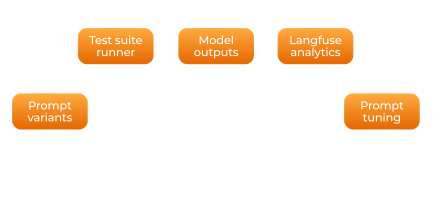
These pipelines are continuously monitored and improved using Langfuse for observability, quality metrics, and continuous feedback loops.
AI-driven test automation
Moving beyond rigid scripts to dynamic systems that learn and adapt helps QA teams to achieve unprecedented levels of efficiency and coverage in their testing processes.
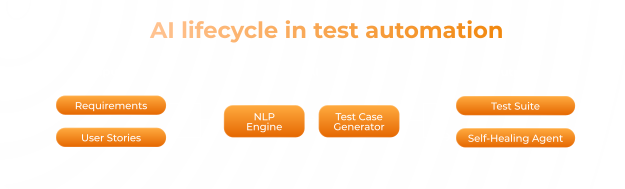
How to apply this trend to your QA projects?

Playwright Auto
Enables natural language-driven test generation, increasing velocity in test case development while keeping tests maintainable.

Intelligent test generation
Intelligent test generation is an evolving field, and while fully unsupervised “auto-mapping” is still maturing, AI algorithms are expected in the near future to analyze historical data, user stories, and requirements. This capability promises to improve coverage and efficiency.

Self-healing capabilities
Maintaining test scripts in the face of UI changes can be a significant overhead. That’s why our frameworks are being enhanced with self-healing capabilities like those found in Katalon, so selectors adapt dynamically as UI components evolve.

Visual regression
By employing Computer Vision and Machine Learning, we can identify visual defects that might be missed by human eyes or traditional testing methods. AI-powered visual comparison ensures pixel-perfect UI across platforms.
Predictive analytics in QA & enhanced defect management
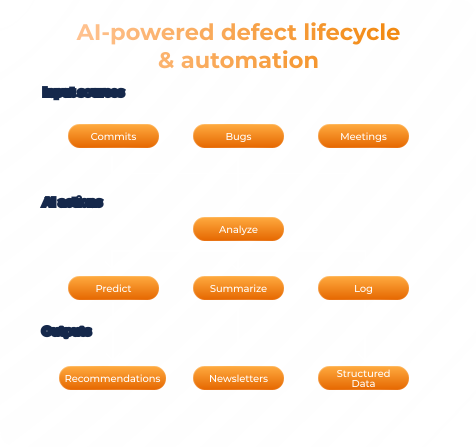
Shifting from reactive to proactive QA. AI is enabling risk-based prioritization based on code history, test failures, and usage patterns. Besides, AI doesn’t just help detect defects — it can now predict, analyze, and help prevent them.
- We use internal tools for predictive test selection, highlighting high-risk code areas before manual QA begins.
- This enables targeted regression, reducing time while increasing the probability of defect discovery.
- We’re experimenting with AI-assisted defect analysis that identifies recurrence patterns and probable causes from past incidents and logs.
- Integrating these insights into our dev lifecycle helps shift QA left — identifying issues at the design or commit stage.
Get your copy of the Patagonian
AI Future Outlook report
AI technologies and tools
DevOps
Architecture
QA
Experience
Development
AI
Tools like GitHub Copilot and AWS CodeGuru assist with writing and reviewing code, while AWS Q supports intelligent troubleshooting and query resolution.
AIOps tools, such as AWS GuardDuty, Kubecost AI, and AWS DevOps Guru, help detect issues early, optimize resources, and minimize downtime.

Agentic AI tools include enterprise platforms with built-in connectors, low-code tools for flexible agents (n8n, Langflow, OpenWebUI), and custom frameworks for highly specialized cases (LangChain, LlamaIndex)..
Mermaid and Eraser.io generate system diagrams, while integration agents connect them with documentation, testing, and scaffolding tools.

Gen AI tools are increasingly valuable in AI-assisted QA workflows. ChatGPT and Claude stand out for their flexibility and accuracy, while Meta AI is also gaining traction.
Playwright Auto transforms natural language into automated test scripts, while N8N streamlines workflow automation through AI-powered agents.
Testing suites include Promptfoo for cross-model prompt testing, Ragas for RAG performance measurement, and Langfuse for real-time monitoring.

ChatGPT is widely used for tasks such as writing, brainstorming, research and analysis, or content creation. Tactiq.io is very helpful for research synthesis and interview analysis.
Tools like Figma AI and Uizard support rapid prototyping, accessibility checks, and design automation, while Midjourney and DALL-E generate custom visual assets and UI elements.
Teams combine LLMs with platforms like Maze AI for faster user testing and simulated feedback. Voiceflow enables comprehensive conversational design and chatbot prototyping.

GitHub Copilot, Cursor and Windsurf are widely used for real-time code suggestions, refactoring, and auto-generating documentation. CodeRabbit helps catch bugs, security or code quality problems before production.
Frameworks like LangChain and LangGraph simplify the process of building context-aware, agent-based applications by orchestrating LLMs with external data sources, APIs, and complex workflows.
LLMs like Claude Sonnet and ChatGPT support code generation, test case creation, data transformation, and question answering.

AI-powered tools are streamlining workflows across the board. Open WebUI and platforms like n8n help build custom AI automations that simplify repetitive tasks.
Copilot and OpenAI Agents support complex workflows by handling multi-step tasks and integrations. Additionally, tools like LlamaParse transform complex documents into clean, structured data for LLM applications.

Want to boost
your operational efficiency?

AI
capabilities
in practice
We are committed to staying at the forefront of AI innovation. These diverse projects offer a glimpse into how we are applying advanced technologies to address real-world challenges and create significant impact.
How can AI provide support using natural language?
ARCHITECTURE
Vectorial hybrid search using MMR algorithms
Our customized Maximum Marginal Relevance (MMR) retrieval algorithm optimizes search results by balancing both relevance and diversity in document selection.
OpenAI’s language models then generate human-like responses.

Built using Retrieval-Augmented Generation (RAG) technology through LlamaIndex to process complex information from a large document corpus.
Seamless WhatsApp integration for a familiar and accessible user experience.
EXPERIENCE
Dynamic interactions with consistent agent personality traits.

71%
Positive feedback

2,500
daily users
CONVERSATIONAL DESIGN

CONVERSATIONAL DESIGN
Scalable, user-centric solution for automated efficiency and personalized interactions.

in real-world projects
How can AI digitize and simplify medical care while complying with official regulation?
How can AI digitize and simplify medical care while complying with official regulation?
LANGCHAIN & OPEN AI
AI HEALTH ASSISTANT

Modern cloud architecture
& interoperability with official healthcare systems
Patients can describe symptoms, upload medical records, and request prescriptions to receive preliminary AI-assisted diagnoses before professional review.

70%
faster service delivery

95%
patient satisfaction
- Legally valid electronic prescriptions (recetario.com.ar).
- Integrated payment system (Mercado Pago).
Dashboard for healthcare providers:

View patient requests and history

Generate electronic prescriptions

Track earnings

How can AI improve language learning and enhance quality control during lessons?
personalized learning experience

GPT 4O REALTIME PREVIEW
AI LANGUAGE COACH
Students can talk to an AI avatar that maintains natural conversation flow and appropriate vocabulary.
User ←→ Backend ←→ OpenAI
GEMINI & WHISPER
high-quality interactions
Our automated AI solution monitors teaching sessions by analyzing video and audio recordings.
Visual behavior recognition

Google’s Gemini (2.0-flash) analyzes session recordings to identify professional conduct compliance.
GEMINI & WHISPER
high-quality interactions
Our automated AI solution monitors teaching sessions by analyzing video and audio recordings.
Visual behavior recognition
Google’s Gemini (2.0-flash) analyzes session recordings to identify professional conduct compliance.

Speech analysis
Whisper AI processes audio, calculates words-per-minute
and detects speaking speed during sessions.
personalized
feedback reports
Recommendations
OUR EXPERTS’ ADVICE FOR LEARNING ABOUT WHAT’S COMING



AI
Future Outlook
Augmented human capabilities & automation
AI is set to transform businesses through intelligent automation and augmenting human capabilities. Powerful open-source workflow automation platforms like n8n act as a central nervous system, connecting AI tools and services and bridging the gap to traditional business applications.
Want to transform your business with AI?

Concepts like Hugging Face SMOL Agents and OpenAI Agents are paving the way for autonomous, collaborative AI entities tackling complex tasks.

Platforms like Azure AI Services provide the infrastructure, while vLLMs ensure efficient scaling and compliance.

Pgvector enables powerful knowledge retrieval, underpinning smarter AI applications.
Imagine this scenario

Imagine using n8n to trigger an OpenAI Agent to generate content. Then, n8n will automatically publish it through your content management system – a prime example of n8n bridging the gap between AI and real-world use. Similarly, n8n can connect to Azure AI services for sentiment analysis and update customer records accordingly, just to name a few examples.
Model Context Protocol (MCP) is emerging, referring to a single, integrated platform or solution that can handle multiple diverse tasks, reducing complexity and increasing efficiency by consolidating functionalities. An example of an MCP is the The HubSpot MCP Server that acts as a secure bridge, allowing AI tools like Claude or Cursor to interact with your HubSpot account using natural language.
DECODING THE AI REVOLUTION: agentic AI, SMOL agents & MMR
Autonomous intelligence
in action
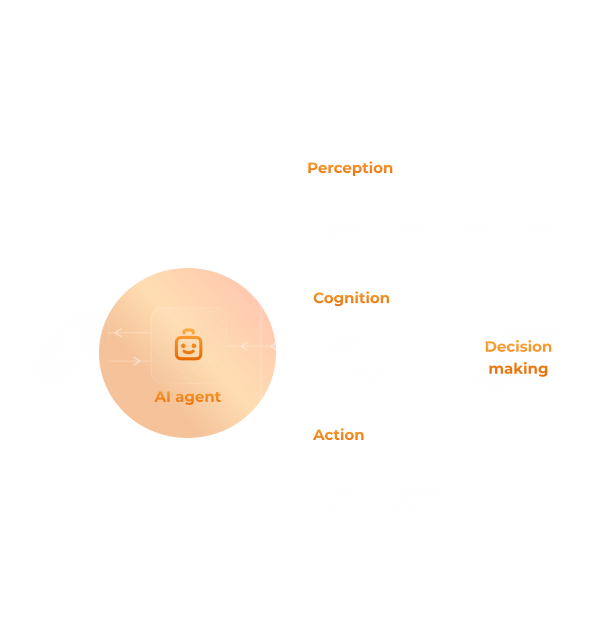
Agentic AI develops autonomous systems that monitor, decide, and act to achieve goals. Key components include perception, planning (leveraging LLMs), memory (powered by vector databases like Pgvector), action (API calls, code generation), and reasoning.
Orchestration frameworks manage multi-agent workflows with human oversight for alignment.
Think of AI agents automating customer service, intelligently processing documents, or acting as autonomous research assistants.

Embedding agentic capabilities into products creates smarter, more adaptive user experiences,
like personalized AI assistants managing schedules and offering proactive recommendations.
Enhanced decision-making in finance, healthcare, and logistics.
Get your copy of the Patagonian
AI Future Outlook report
Hugging Face
SMOL Agents:
Specialized AI for efficiency
It’s a streamlined way for developers to build intelligent helpers, called agents. This ability to “think in code” allows them to tackle complex jobs in a uniquely direct and efficient way, going beyond simply interpreting instructions.
On a more technical level, smolagents provide a minimalist framework for constructing AI agents. Its core is incredibly lean, around just 1,000 lines of code, which cuts down on overhead and makes it easier to understand and work with.
Picture building with LEGOs, but instead of just following instructions, some of your special bricks could actually build new LEGO structures themselves to solve a problem!
This framework isn’t limited to just one type of agent: It supports code agents, where the AI can actually write and run code (in secure environments like E2B) to solve problems.
It also handles traditional tool-calling agents, which interact with external tools by generating structured instructions.
This flexibility allows developers to leverage the strengths of different Large Language Models (LLMs) and choose the best approach for the task at hand.This flexibility allows developers to leverage the strengths of different Large Language Models (LLMs) and choose the best approach for the task at hand.
Compared to agents that don’t use code
Practical applications
of specialized agents
Smolagents emphasize simplicity and efficiency.
They can lead to faster development cycles and lower operational costs for businesses. This makes sophisticated AI more accessible for targeted needs.

Swiftly summarize
customer feedback.

Automatically generate
robust unit tests
for your software.

Efficiently extract
key information
from legal documents.
MMR is an algorithm that selects a diverse yet relevant set of results or summaries, reducing redundancy.
It balances relevance to a query with dissimilarity among selected items using similarity metrics and a weighting parameter.
MMR enhances user experience in search, recommendations and AI agent outputs by providing comprehensive yet non-repetitive information.
This leads to increased user engagement and better-informed decisions when AI agents present retrieved data.
Start your AI business journey:
Request an expert AI consultation!
The future is intelligent!
Are you ready?